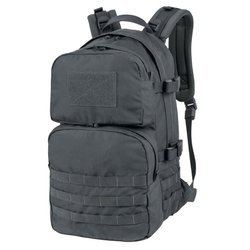
Tactical backpack, small or large?

Depending on our lifestyle, the way of transporting the most necessary items may differ dramatically. The basic question that we should ask ourselves is whether we need a backpack for this. If the answer is yes, you may find our tutorial helpful. Due to the wide range of volumes, the article was based on the products of the Polish brand Wisport, however, it can be applied to any manufacturer.
The key condition for selecting a backpack is to determine the volume and dimensions corresponding to the situation in which we will use it. A common problem in making the right decision is the willingness to buy a "universal" model that will serve us both during city trips or short field trips, as well as for multi-day trekking. Then you should consider first of all what is the average length of our trips. For fans of trekking or multi-day survival expeditions, 60-liter expedition backpacks will be the most appropriate. However, people who prefer one- or two-day trips, but would like to use a solid backpack also in the city, should consider choosing a model with a smaller capacity, with the possibility of carrying their equipment outside. Useful for this purpose will be both straps and MOLLE / PALS belts, which also allow the installation of additional pockets.
 The organizers are a valuable addition to both city and expedition backpacks The organizers are a valuable addition to both city and expedition backpacks |
The next, equally important element is the carrying system used in the backpack. In ultra-compact city backpacks, into which we plan to put a light jacket, water and snacks, a stiffened panel in the back and light, padded shoulder straps will suffice. In higher and higher models, in which we plan to carry more and more loads, we can slowly pay attention to such amenities as an optional stiffening strip or bold pillows in braces. Backpacks over 35 liters should already be equipped with a waist belt, while in expedition backpacks an extremely important element will also be the frame and the adjustable carrying system.
 The SAS system is available in several versions, differing in the degree of filling and regulation The SAS system is available in several versions, differing in the degree of filling and regulation |
The manufacturer's choice of materials is very often an indicator of the overall quality of his products. In the case of typically tourist backpacks, due to their low weight, ultra-light materials such as 210D polyester or Robic® nylon are used. For tactical and outdoor applications, we strongly recommend DuPont Cordura® with a density of 500 or 1000 D. With a relatively low weight, it is characterized by an extraordinary mechanical strength, while being resistant to weather conditions. This is due to the internal structure of the fibers and the use of a polyurethane coating with a Teflon finish. Choosing a backpack made of such material will guarantee us reliability and many years of use. A cheaper alternative to Cordura is polyurethane-coated polyester in the same density range. It is not as durable, but it will fulfill its role properly in the field.
 Cordura® fabric comes in many color variations, including Coyote Brown and RAL 7013 Cordura® fabric comes in many color variations, including Coyote Brown and RAL 7013 |
Mechanical elements also play a large role in the design of the backpack. The quality of the buckles is determined not only by their correct and smooth operation, but also by the durability of the material they are made of. Manufacturers such as Duraflex® or ITW Nexus set the standard in their market segment. Users using backpacks during the service will appreciate ITW's GhillieTEX ™ solution that reduces the visibility of the buckles in the infrared range. Thanks to this, the buckles do not "shine" in the night vision goggles, which can often be found in this type of constructions. The best reputation among zippers is enjoyed by the products of the Japanese brand YKK®, also available in splash-proof versions.
Returning to the topic of volume, backpacks with a tactical profile can be divided into several very fluid categories.
Compact, EDC and city backpacks
They are most often produced based on the design of their bigger brothers, thanks to which they combine tactical styling with small dimensions, usability and rather conventional support of the user while wearing. Nevertheless, they will be a great choice for people with a typical urban lifestyle, as they will be perfect both for everyday use and for day trips in the field. The main valuable feature here is a good combination of small external dimensions with high packing. Their volume is usually in the range of 15-25 liters, with some exceptions, with a capacity of 5 liters more or less. The basic feature of an everyday backpack should be easy accessibility and manipulation inside the compartments. Long zippers on most of the circumference will be valuable, as well as additional side accesses, making it easier to remove, for example, a bottle without removing the backpack. Certainly, the spare compartment for a laptop and organizers, whether in the form of elastic bands or a pocket system, will be worth paying attention to. In the case of the Sparrow II series backpacks, in addition to the necessary elements, we get a set of nuances that will turn out to be useful in outdoor applications. The buckles for mounting the straps will allow you to carry e.g. a fleece outside, and the quickly detachable harness, in addition to the safety aspect, will allow you to mount the backpack as a pocket on larger models. During trekking, holders for the hydration system, internal for the bag and external for the tube will also be a valuable accessory.
 Sparrow II backpacks come in many colors and camouflages Sparrow II backpacks come in many colors and camouflages |
Patrol backpacks
Their volume (30-45 l) most often allows you to pack for a day-long trekking and spend the night in the field. In addition to the features distinguished in the previous category, valuable elements will also be filled with soft material, for example EVA foam, braces, necessarily with a chest strap, and a very useful, even very simple, hip belt. It will transfer the weight to the strongest parts of the body, lower the center of gravity of the backpack and stabilize its movement. Straps will also be useful: they will allow you to mount the foam pad and the tent outside, and by compressing, they will allow you to adjust the dimensions of the backpack to the content. During higher loads, we will also need stiffening elements, such as, for example, a single, centrally placed aluminum strip. In addition, you should look at the back for adequate comfort and ventilation, so foam segments will be a good solution, between which air will be able to circulate without any problems.
 The MOLLE / PALS straps on the backpack allow you to increase its capacity with the help of pockets The MOLLE / PALS straps on the backpack allow you to increase its capacity with the help of pockets |
Three-day and expedition backpacks
The largest models intended for multi-day trekking should primarily be characterized by high comfort. It will be important not only to make the backpack, but also to select it appropriately for the user's body. Reputable manufacturers often offer systems that allow you to easily adapt the system to several sizes, depending on the height. A common system is a flat hook on a belt with loops corresponding to sizes S, M, L, XL, or the stepless adjustment with straps used in the Raccoon model. A must here is a well-positioned frame and a spacious and properly padded hip belt, thanks to which it will distribute the weight better. A feature of good multi-day backpacks is also a wide range of changing their volume. Thanks to the compression straps and the folding chimney, we will be able to easily reduce the backpack along with the depleting food, or increase it if necessary. Due to the difficulties in long-term weather forecasting, unlike smaller models, top-loading systems with a flap instead of a zipper will work here. This will translate into greater content security. A waterproof cover that folds out from the bottom will also be a nice touch.
 |
 |
| Backpack compression potential: 65 liter Raccoon with 35 liter Whistler, partially filled and fully filled | |
Polecane
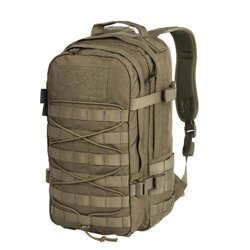
Helikon - Plecak taktyczny Raccoon Mk2 - MOLLE/PALS - Cordura - Coyote - PL-RC2-CD-11