Quick look on sunglasses

As it is commonly known, any excess is harmful and it is no different in the case of ultraviolet radiation. Despite some undoubted benefits, such as help in the formation of vitamin D3 or an attractive tan, the UV range carries several serious risks. One of them is photochemical cataract - clouding of the lens caused by long-term exposure to radiation. A great way to protect yourself from it is to use sunglasses with an appropriate filter, and for questions on how to properly choose them and distinguish sunglasses from those that only pretend to be them, the Specshop.pl store will answer in this guide.
The value of glasses used to protect eyesight can be identified primarily by the standards they meet regarding radiation filtration, the optical class, i.e. the absence of image distortions and the filter category. The main factor that should be taken into account is the extent to which the filter eliminates harmful rays. The UV400 marking guarantees protection in the full range of ultraviolet radiation, i.e. up to 400 nm. This value guarantees complete eye safety. Many glasses provide full UVA and UVB filtering. Theoretically, these types of radiation are the most harmful to the eyes, while UVC has a more comprehensive effect.
We can also meet the markings of the EN170 standard with values from 1-5, as in the case of Bolle products. However, they are most often given with utility glasses for working with ultraviolet sources. In this case, the quality of filter protection increases with its numbering.
 Zarówno przezroczyste jak i barwne wizjery mogą chronić przed promieniowaniem UV Zarówno przezroczyste jak i barwne wizjery mogą chronić przed promieniowaniem UV |
In the case of sunglasses, a common parameter is the degree of protection category. It ranges from 0-4 and is a reliable indicator of the usefulness of the accessory that we plan to buy. Category 3 models are best suited for everyday use in intense sunlight. Below is a brief description of each category.
Category 0: Glasses for aesthetic purposes only, do not protect or protect to a very limited extent against UV radiation. Very low glare reduction potential.
Category 1: Like category 0, these are not sunglasses. Thanks to greater dimming, they reduce glare a bit better, but still do not provide eye protection at the appropriate level. They are also not suitable for driving at night.
Category 2: Sunglasses with a medium glare reduction and good UV protection. They cannot be used to drive vehicles at night and in poor lighting.
Category 3: Category meeting high standards of UV protection, also providing comfort due to very good glare reduction. Glasses of this type provide good protection against the dangers of radiation. They cannot be used to drive vehicles at night and in poor lighting.
Category 4: Specialized glasses with above-average glare reduction and excellent UV protection. Mostly intended for conditions in which the sun's rays are intensely reflected from the ground - snow or ice. Perfect for alpine climbing and during trips to the Arctic Circle. They are not suitable for driving under any lighting conditions.
 |
 |
| At first glance, polarized glasses do not differ from ordinary glasses - the effect is visible, however, immediately after putting on | |
A valuable treatment used in some models is the polarization of the lenses. The use of polarization in the lenses makes them eliminate glare caused by flat surfaces. It is especially valuable when staying over water bodies where a smooth surface of water acts as a mirror reflecting unpolarized light, as well as when driving vehicles on long, illuminated sections of the road. Polarized lenses also improve the contrast, improve the comfort of the eyes and better reflect the real colors of the environment, which is why we recommend them for every user. However, due to the technologies used in some types of displays in mobile devices or navigations, polarized glasses can significantly hinder or even prevent the use of this type of accessory. So they work best in cases where we are exposed to large areas that reflect light.
The last aspect is the choice of visor colors. Contrary to what it may seem, color is not a purely aesthetic treatment, but it is precisely it that predestines the use of lenses for a specific lighting and application.
Due to the fact that eye fatigue is usually caused by visible blue radiation, red or pink lenses will reduce this problem. They will also improve visibility and contrast. Brown and copper lenses function in a similar way, but change the color to warmer and provide greater darkening.
Lenses with darker colors will allow for greater protection against the glare of the sun. This is because they show lower transmission of visible light. However, this is combined with a greater darkening of the image. A good solution is then to use lenses with green colors that combine tinted and contrasting features. They lighten the shadows, reduce glare well and have a soothing effect on the eyes. All types of lenses can be in mirror versions, which additionally reflect part of the visible radiation.
 The right choice of lenses can enhance the natural qualities of our eyesight The right choice of lenses can enhance the natural qualities of our eyesight |
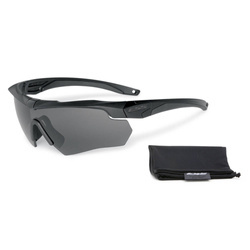
Paying attention to these parameters should help you make the right choice. However, it should be noted that some companies use different classification systems and individual technologies, such as Prizm in Oakley glasses. On the other hand, the form of the frame and the viewfinder is an individual choice. It depends to the greatest extent on the taste, however, for people who appreciate mainly functional values, we recommend models with an open frame and a large visor, such as the ESS Crossbow. They combine a very wide field of view, perfect image with mechanical eye protection thanks to a ballistic viewfinder.
APPolecane